
Options
What are they?
Options are derivative financial contracts that give the holder the right, but not the obligation, to buy (in which case the Option is known as a CALL) or to sell (in which case the Option is known as a PUT) a certain underlying (which may be a share, an index, a currency, etc.) at a predetermined price (known as the STRIKE PRICE) in return for the payment of a premium.
If the right can be exercised only on the expiry date then the option is defined as a EUROPEAN TYPE. If, on the other hand, it can be exercised at any time up to the expiry date, the option is defined as an AMERICAN TYPE.
Options on the FTSE MIB (MIBO), the DAX, the EUROSTOXX and on the American indices are European whereas those on individual equity securities are American.
CALL and PUT options can be purchased or sold, and can obtain extremely different return profiles.
DEFINITIONS
Underlying: the underlying financial asset can be a share, an index, a currency, a government bond, a future contract or any other transferable security (e.g. Fiat, FTSE MIB, Dollar/Euro) for which it is possible to identify official prices.
Contract multiplier: if the underlying is made up of an index, a monetary value is attributed to each unit of the same. In the case of Options, each point on the FTSE MIB has value of 2.5 euros, on the DAX index each point has a value of 5 euros, on the EUROSTOXX50 the value of each point is 10 euros and on American indices each point has a value of 100 Dollars.
Minimum lot: the “multiplier” to be used to identify the size of an individual contract. The minimum lot for share options indicates the number of shares covered by a single option contract traded on the IDEM market and set by Borsa Italiana. For example, if the minimum lot of the option on X is 1,000, each option contract on X, which can be traded on the IDEM market, governs 1,000 shares.
Contract size: for MIBO, DAX, EUROSTOXX and US options, the contract size is the product of the strike price (in index points) and the contract multiplier. The value of the individual trade for stock options is determined by the product of the underlying and the minimum lot, which varies depending on the instrument.
Premium: the price paid by the investor on acquiring the option. It represents the maximum loss that can be incurred. The invested amount is equal to the product of the premium in index points and the contract multiplier. Conversely, for options on securities, it is the product of the price of the underlying and the minimum lot.
Strike price: the price of the underlying at which the investor can exercise the option. In this case, the price may be adjusted in the event of any extraordinary transactions (capital increases, mergers, spin-offs, etc.). Such adjustments are aimed at keeping the investor's position unaltered.
Changes in the underlying can modify the value of an option and, depending on its position in respect of the strike price, call options can be defined as:
- in the money: when the underlying value is greater than the strike price;
- out of the money: when the underlying value is lower than the strike price;
- at the money: when the two values are close.
Conversely, put options can be defined as:
- in the money: when the underlying value is lower than the strike price;
- out of the money: when the underlying value is greater than the strike price;
- at the money: when the two values are close.
Expiration Date: The date by which the option can be exercised and when the final amount is paid. This is usually the third Friday of the month at 09:10 hours.
Option style: Options may be exercised on the expiration date (European) or at any time during the life of the option (American).
Contracts on the FTSE MIB, DAX, EUROSTOXX and on US indices are European and are therefore settled in cash only on the expiration date. Those on individual equities are settled through the physical delivery of the securities.
Use of options:
- Simple directional strategies: they make it possible to invest in a market trend (bullish or bearish) with financial leverage.
- Hedging strategies: they hedge the investments in portfolio against possible impairment losses.
- Complex directional strategies: they simultaneously combine the purchase and sale of Put and Call options. Some strategies also envisage the use of underlying instruments (shares, indexes, etc.).
- "Long short" strategies: they combine the purchase of a Call or a Put option with the purchase or the short sale of one or more shares or indexes. Alternatively, futures can also be used.
The price of an option
The price of an Option is the premium that the buyer pays to the seller. Theoretically, the price of this instrument is made up of two components: INTRINSIC VALUE and TIME VALUE.
Intrinsic value: in an option this component is present only when the instrument is "in the money".
Or, for Call options: current price > strike price;
for a Put: strike price > current price.
The intrinsic value for a Call is the current price minus the strike price, while for a Put it is the strike price minus the current price.
The option must be exchanged at a price that is at least equal to the intrinsic value.
Therefore, the intrinsic value is an objective datum which follows the evolution of the difference between the strike price and the market price of the underlying asset.
Time value: the value attributed to the probability that, by the expiration date, the intrinsic value of the option will increase and therefore be exercised.
Until the expiration date is reached, the time value remains positive as the probability that the option will be exercised is always greater than zero.
However, the time value will inevitably decrease over time until it is zeroed at the expiration date.
The price of out-of-the-money options entirely reflects the time value since the intrinsic value is zero.
The most important qualitative aspect is precisely the time value, specifically for "out of the money" and "at the money" options. Indeed, the high reactivity of the options to changes in market variables is attributable to this component.
Therefore, the time value reflects the market forecasts about the future evolution of the current underlying price and also of a series of variables, which are:
- the greater or lesser proximity to the expiration of the option
- the volatility of the underlying asset
- the interest rate level.
Calculating the price of an option
In order to calculate the price of an option, the following parameters must be considered:
- Price of the underlying
When there is an increase (or decrease) in the underlying asset, the premium of a Call option also increases or decreases, whereas that of a Put option decreases (or increases). - Strike price
The price at which the right to purchase or sell the underlying can be exercised. It is set by the option's seller when opening the financial contract and may be higher, lower than or equal to the current price of the underlying. - The volatility of the underlying asset
The volatility shows the extent of the probable change in the price of the underlying: a highly volatile security is exposed to significant fluctuations in either direction. The volatility does not reflect the direction of the change, but its extent.
The greater the volatility of the underlying, the greater the possibility of making a profit: for this reason, options are more valuable when there are high levels of volatility and less so in periods of reduced volatility (fluctuations in the underlying do not necessarily have to be significant).
Example: let's consider two securities, A and B, both with the same start and end prices, over a period of 10 days:
|
Day |
Price security A |
Price security B |
|
1 |
5.00 |
5.00 |
|
2 |
5.25 |
5.05 |
|
3 |
5.60 |
5.10 |
|
4 |
6.20 |
5.20 |
|
5 |
7.00 |
5.50 |
|
6 |
6.10 |
5.20 |
|
7 |
5.40 |
5.40 |
|
8 |
4.80 |
5.80 |
|
9 |
4.20 |
4.10 |
|
10 |
5.00 |
5.00 |
|
Volatility |
80% |
44% |
- Both shares have the same start and finish prices, but follow a different path during the period of time analysed: the price of security A has in fact fluctuated, both upwards and downwards, much more than security B, which showed greater volatility.
There are two types of volatility:
> Historical volatility: this expresses the scale of the fluctuations recorded in the current value of the underlying in relation to the average value recorded over a given period of time. Those using this concept assume that the level of volatility, calculated on the reference price, will tend to reoccur in the future. From a trading point of view, therefore, classic statistical tools are used (observation of historical data and forecasts for the future) to determine the level of volatility to be included in the model. Due care must be exercised as the volatility tends to change continuously and past estimates can turn out to be incorrect for the future.
> Implied volatility: this reflects the greater overall value of the options market in relation to its intrinsic value. Implied volatility reflects the summary of the forecasts made at the time by the market with regard to the scale and frequency of future fluctuations in the price of the underlying. The price of an option depends on the implied volatility, which is the most important variable to be monitored for those who intend to trade on this type of instrument.
Professional traders often refer to themselves as buyers and sellers of volatility. - Expiration date
As the expiration date draws near, the time value component tends to progressively decrease until it gets to zero. On a like-for-like basis, the further away the expiration date, the greater the value of the option. - Interest rate and expected dividends
Contrary to what might be expected, there is a direct correlation between interest rates and the value of an option (i.e., the value increases) in the case of a Call option, and a reverse one (i.e. the value decreases) in the case of a Put option.
When we purchase a Call option, we commit only a part of capital (= the premium), while the remaining amount can be invested in risk-free assets at a higher rate: this implies an increase in the value of the Call option.
Alternatively, the Call Option entitles us to purchase, at a certain amount, a financial asset at a price that, after discounting the interest rate (r), will be equal to X/(1+r). If the interest rate increases, the price of the underlying will tend to decrease following an increase in the denominator (1+r). This means that a Call option is worth more.
An increase in the expected dividends results in a decrease in the value of the Call option on the underlying asset, whereas Put options increase in value because the value of the securities decreases by the amount corresponding to the detachment of the coupon.
Summary table:
|
Variable |
Call value |
Put value |
|
|
Price of the underlying |
|
|
|
|
Strike price |
|
|
|
|
Volatility |
|
|
|
|
Expiration date |
|
|
|
|
Interest rates |
|
|
|
|
Dividends |
|
|
|


Trading on the Fineco website and PowerDesk
To start trading, just select the "Options" list from the side menu on the Fineco website, under "Futures and options" or from the menu of the baskets available on PowerDesk.
- From the Fineco website: You can access the lists of tradable options directly from "Futures and options" in the side menu under "Markets and trading".
By clicking on the selected instrument in the list of tradable options, a security sheet will be displayed containing all the expiration dates and the CALL and PUT strike prices.
In order to trade, just click on the selected strike price and open the order book.
Each transaction is displayed in the general orders monitor or in the related book monitor. Once purchased, each contract is displayed in the securities portfolio. - On PowerDesk: When launched, the Options centre will be displayed, i.e., the popup completely dedicated to options trading. The window can be enlarged or reduced at will by selecting and pulling the bottom right corner. All the current expiration dates available and traded on the IDEM market are displayed in the popup heading.
Click on "Advanced Search" to run a more specific request by cross-referencing several variables simultaneously. At the centre of each row, on a yellow background, the strike price of each contract will be displayed. To the right of the strike price, for each level, you will see all the Put contracts, while to the left of the strike price, all the Call contracts.
Trading: double click on the row of each contract (to the right for Puts, or to the left for Calls) to display the powerboard with the book, the orders monitor, the order entry and time and sales.
Each transaction is displayed in the general orders monitor or in the related powerboard monitor. Once purchased, each contract is displayed in the securities portfolio.
The profit and/or loss for each closed position is shown in the "P&L" popup.
Similarly to any PowerDesk list, you can customise the skin colour and the font size of the Options centre (from the preferences panel).
Important: should you decide to bring an Option to its expiration, the contract is displayed in the securities portfolio and may be traded up to the day (17:40 hours) prior to the closing day. It is then removed from the customer portfolio and can no longer be traded.
Fees: costs amount to €3.95 for each lot processed. A reduced commission of €2.95 is applicable where commissions paid exceed € 500 in one month for the IDEM and EUREX markets. A reduced commission of €1.95 is applicable where commissions paid exceed € 10.000 in one month for the IDEM and EUREX markets. The reduced commission rate is maintained for the following month.
The fee for US options is $3.95 per lot. Reduced commission of $2.95 is applicable where commissions paid exceed $500 in one month for the CBOE and CME markets. Reduced commission of $1.95 is applicable where commissions paid exceed $10.000 in one month for the CBOE and CME markets. The reduced commission rate is maintained for the following month.
Ceilings: you cannot place orders for more than 39 lots. However, there are no limits on the number of lots per position.
Buying a Call or a Put option
Purchasing a Call option
This type of instrument may be used when the investor expects the value of the underlying to increase. The difference between the purchase of the latter and that of the option is that the purchase of the underlying entails the risk of incurring considerable losses if the shares go down, whereas with the option, the maximum possible loss is that of the premium paid.
Furthermore, you can take advantage of the leverage effect that makes it possible to increase earnings. Indeed, these instruments have more price variations than their underlying assets. With regard to a Call option, the leverage effect reflects the increase in the option price in respect of a percentage variation of the price of the underlying (in the case of a Put option, it reflects an increase in the option due to a percentage reduction in the underlying).
Example: Suppose we purchase a CALL option on the X index with a Strike Price of 35000, an expiration date of December 2005 at a price of 160 index points (€400). Let’s consider exercising the option: if the quote of the underlying is more than 35000, we will obtain a profit equal to the difference between the current quote of the underlying and 35000 multiplied by 2.5 (see contract features).
If, for example, the daily index on the expiration date quotes 37000, by exercising the option we will earn €5000 ([37000-35000]*2.5) for each contract purchased. The performance for the period would be equal to more than 100% in respect of a 12% variation of the underlying.
This highlights how the use of options, exclusively for purchase transactions, makes it possible to exploit the leverage effect, thus increasing earnings and reducing losses to a set limit (equal to the price of the premium paid to purchase the option).
Clearly, the possibility of such an event occurring is very limited.
Let's assume that, on 30 April 17, an investor purchased a CALL option on Y share with a strike price of 14, expiration date in July 2007, at a price of €0.48, which, multiplied by the minimum lot of 100, results in an overall investment of €48 and that the share price is equal to €13.5. After 30 days, let's assume that, with the underlying at €14.37, the derivative is exchanged at €0.7845. The investor may decide to monetise the earnings by selling on the market or opt to exercise the option early. However, the second alternative is not economically wise as the investor would gain €0.37 (€14.37-€14) compared with a market price that is more than twice the amount earned by exercising the option.
By selling on the market the investor could earn €0.784*100 = 78.4, with a 62.6% increase on the initial investment.
Purchasing a Put option
This type of instrument can be used when the investor expects a decline in the value of the underlying. The difference between short selling the latter and the option is that the sale of the underlying entails the risk of incurring considerable losses if the quotes go up, whereas with the option, the maximum possible loss is that of the premium paid.
Example: Let's assume you bought a Put option on the X index with a Strike Price of 34000, an expiration date in December 2005 and a price of 930 index points (€2325). Upon exercising the option, if the quote of the underlying is below 34000, you will obtain a profit equal to the difference between the strike price (34000) and the quote of the underlying.
If the index closes at 32000, the profit for the holder of the derivative would be equal to 34000-32000=2000 index points, which multiplied by €2.5, the multiplier of the relevant financial contract, is equal to €5000, against an investment of €2325.
Let's assume that, on 30 April 17, an investor purchased a PUT option on Y share with a strike price of €8.2, expiration date in July 2007, at a price of €0.32, which, multiplied by the minimum lot of 1000, results in an overall investment of €320 and that the share price is equal to €8.2. Let's assume that, after 30 days, the underlying has dropped to €7.85 and the derivative is valued on the market at €0.43. The investor can either sell or exercise the derivative, though the latter possibility is not economically wise as it would return only €8.2-€7.85 = €0.35, which is lower than the stock market price. Reselling the PUT option on the market would result in a profit equal to €0.43 - €0.32 = €0.11 which, multiplied by the minimum lot of 1000, would return €110, a performance of 35.8%.
Options versus Futures
When an investor has a certain idea on the underlying, when is it better to invest in options and when in futures?
The payoff of the two instruments is undoubtedly different: the losses with the options are limited to the premium paid while, theoretically, with futures, any negative performance could be unlimited. This difference can be eliminated through the use of "stop-loss" orders.
The main difference lies in the increased interpretative complexity of options: indeed, with options, there are many variables at play but this is not the case with futures.
In fact, anyone investing in options needs to bear in mind that options lose value over time as well as their volatility. An increase in this variable leads to an increase in the value of the instrument and vice versa in line with the level of the underlying.
The financial leverage of options can be very high, which gives the instrument a certain aggressive and, consequently, more speculative connotation (if the investor is directional).
Selling a Call option
Short sale of securities options
Thanks to Fineco's PowerDesk platform you can perform short sales of Call options.
This transaction is only possible provided that the customer owns the underlying, i.e., the securities in portfolio. Conversely, the short sale of Put options is never permitted.
Through the short sale of Call options, customers sell the right to purchase the underlying at the strike price, collecting the premium which will be credited to the current account on the second trading day after the position opening.
For customers, the short sale of a Call option implies the unavailability of the underlying securities throughout the term of the transaction. Consequently, it will not be possible to sell the securities that comprise the underlying of the Call option sold until the latter is in the customer's portfolio. Any attempted sale of the underlying will display an error message.
After the sale, the option may be closed upon expiration or before the expiration of each contract through an opposite transaction, i.e., by purchasing the same number of lots previously sold. The contract can be sold normally on the market before its expiration. The gain or loss for each transaction is the difference between the sale price and the purchase price multiplied by the number of owned lots.
If closing occurs on the expiration date, the gain or loss is calculated as the difference between the market price of the underlying and the strike price multiplied by the number of lots.
Exercise before the expiration date
When the customer is exercised by a third party prior to the expiration date, both the underlying comprised of the securities and the short option will be cancelled from the customer's portfolio. The transaction will be notified to the customer by e-mail.
Note: Holders of sub-accounts of current accounts cannot carry out short sales of Call options on the stocks in the bearer's portfolio.
Trading stock options
Through its PowerDesk platform, Fineco enables you to trade on stock options and derivatives which have nearly all the components of the FTSE MIB and some stocks of the FTSE Italia Mid Cap as their underlying. Single options enable investors to take bullish (call) or bearish (put) positions on the single underlying.
This type of option is called "American" and may therefore be exercised every day up to the end of the contract except in the following cases: 1) in the session prior to the day of distribution of the dividends of the stock underlying the contract; 2) in the session prior to the day when capital transactions begin on the stock underlying the contract; 3) on the last day of an IPO concerning the underlying stock.
Options assign the purchaser the right, but not the obligation, to purchase (in the case of call options), or to sell (in the case of put options), a certain quantity of lots of underlying securities at a predetermined price (strike price) on a specific date (European-style option).
Trading
You can purchase all the Option expiry contracts on stocks traded on the IDEM market.
Short selling transactions are only allowed on Call options for those who hold the underlying securities.
To open a long position you must pay a premium, which is the maximum potential loss that the investor might suffer.
Unlike Futures, the purchase of a Call/Put on a single option does not entail the payment of any margin as collateral. Following the purchase, the Option may be closed on or prior to the expiration date of the individual contract.
The contract can be sold normally on the market before its expiration. The gain or loss for each transaction is the difference between the sale price and the purchase price multiplied by the number of owned lots.
If closing takes place at expiration, there will be the physical delivery of the underlying for in-the-money options, or the option will be cancelled from the portfolio (out of the money) with a loss equal to the premium paid.
If the position is closed before the expiration of the contract, the Option is traded on the market and the profit or loss on the position is calculated as the difference between the sell price and the book value. For each expiration, trading is possible until the market closure (17.40 hours) on the day prior to the end of each contract (usually on Friday mornings).
Each contract is displayed in the securities portfolio until the evening before the last trading day.
Premium settlement
The premium is settled in cash only on the first business day following the trade date of the contract, through the Clearing House.
Exercise prior to expiration
Should the option be in the money prior to expiration, the owner can exercise the option early. However, excising a Call option early is almost never convenient, except on the day before the detachment date of a dividend and provided that the dividend yield is higher, at that particular time, than the risk-free interest rate.
In the case of an American-style Put option, the results are not unique, but, generally, they should never be exercised early.
In general, options are worth more "alive" than "dead", since they consist of an intrinsic part (the difference between the stock price and the strike price for Call options and vice versa for Put options) and by another defined as time-related (which characterises said options). Therefore by choosing to exercise the option early, you would not benefit from the time-related component, i.e., the probability that the price of the underlying will move further away from the strike price.
Stock options: contractual features
The features of stock options are described below.
|
Feature |
Description |
||||||||||||||||||||||||||||||
|
Underlying and minimum lots |
|||||||||||||||||||||||||||||||
|
Option style |
American |
||||||||||||||||||||||||||||||
|
Trading hours |
From 8:00 to 16:50 |
||||||||||||||||||||||||||||||
|
Trading unit |
Stock option contracts are quoted in Euros. |
||||||||||||||||||||||||||||||
|
Premium settlement |
The premium is settled in cash only on the first business day following the trade date of the contract, through the Clearing House. |
||||||||||||||||||||||||||||||
|
Contract size |
The contract size is the product of the value of the strike price (in Euros) and the respective lot. |
||||||||||||||||||||||||||||||
|
Contract premium |
The contract premium is the option premium multiplied by the respective lot. |
||||||||||||||||||||||||||||||
|
Minimum price movement (tick) |
The minimum price movement is €0.0005 |
||||||||||||||||||||||||||||||
|
Traded expiration dates |
The closest two monthly expiration dates, the next four quarterly expiration dates of the ‘March, June, September and December’ cycle and the four half-yearly expiration dates (June and December) expiring within the two years following the ongoing year are quoted simultaneously on PowerDesk. A new monthly expiration date (quarterly or half-yearly) is quoted on the first trading day following the expiration day. |
||||||||||||||||||||||||||||||
|
Expiration date |
Contracts expire on the third Friday of the expiration month at 08:15 hours. If the stock exchange is closed on that day, the contract expires on the last trading day preceding it. |
||||||||||||||||||||||||||||||
|
Last trading day |
Trading on expiring series ends on the day preceding the day of their expiration, at 17:40 hours. |
||||||||||||||||||||||||||||||
|
Daily closing prices |
The daily closing prices are set by the Clearing House. |
||||||||||||||||||||||||||||||
|
Settlement price |
The settlement price is the value of the reference price of the underlying contract on the last trading day.. |
||||||||||||||||||||||||||||||
|
Option exercise |
Early exercise is possible during the entire trading session on any day between the first trading session and the last trading day. Early exercise entails a fee of €49.95 for each lot in the portfolio. There are no commissions for the purchase or sale of the underlying securities, neither in the case of early exercise nor in the case of exercise at maturity. N.B. In the event of partial exercise at expiry of long call and long put options, a commission of € 49.95 per lot will be applied for the exercised lots. Early exercise is suspended in the following cases:
|
||||||||||||||||||||||||||||||
|
Settlement |
Settlement takes place with the physical delivery of the securities to the Clearing House taking into account the number of contracts exercised and the minimum lot. The contract is settled on the third business day following the early exercise of the option or the expiration date of the same. |
||||||||||||||||||||||||||||||
|
Limit on the number of positions opened or exercised |
No limit. |
||||||||||||||||||||||||||||||
|
Strike prices |
The strike prices are generated according to the intervals indicated in the following table:
|


Options on the FTSE MIB index
Through its website and the PowerDesk platform, Fineco enables you to trade on Mibo Options, derivatives which have the FTSE MIB as their underlying instrument.
Since the FTSE MIB index lists the most liquid and most highly capitalised stocks on the Italian stock market, these options enable investors to take a bullish (call) or a bearish position (put) on the entire market.
This type of option is called "European" and may therefore only be exercised at the end of the contract. Options on the FTSE MIB index assign the purchaser the right, but not the obligation, to purchase (in the case of call options) or to sell (in the case of put options), the benchmark index of the Italian Stock Exchange at a predetermined price (strike price) and on a specific date (European-style option).
Trading
You can purchase all the Option expiry contracts on the FTSE MIB index traded on the IDEM market.
To open a long position you must pay a premium, which is the maximum potential loss that the investor might suffer. Unlike Futures, the purchase of a Call/Put FTSE MIB Option does not involve the payment of any margin as collateral. Following the purchase, the Option may be closed on or prior to the expiration date of the individual contract.
The contract can be sold normally on the market before its expiration. The gain or loss for each transaction is the difference between the sale price and the purchase price multiplied by the number of lots owned multiplied by 2.5.
If the closing occurs on the expiration date, the gain or loss is calculated as the difference between the market price of the underlying and the strike price multiplied by the number of contracts multiplied by 2.5 (the multiplier).
If the strike price of a Call option is less than the price of the underlying (in-the-money expiration date) the Option is exercised and the profit is calculated using the above formula. The opposite applies to Put options.
Otherwise, the Option is defined as out-of-the-money and cannot be exercised at its expiration. In this case, the purchaser suffers a loss equal to the premium paid.
If the position is closed before the expiration of the contract, the Option is traded on the market and the profit or loss on the position is calculated as the difference between the selling price and the book value.
For each expiration, trading is possible until the market closure (16.50 hours) on the day prior to the end of each contract (usually on Friday mornings).
Each contract is displayed in the securities portfolio until the evening before the last trading day.
Premium settlement
The premium is settled in cash only on the first business day following the trade date of the contract, through the Clearing House.
Note: For all options, both on FTSE MIB index traded on IDEM exchange and on DAX and EUROSTOXX indices traded on EUREX exchange, short selling trading activity is not available.
Options on the FTSE MIB index: Contractual features
The features of options on the FTSE MIB index are described below.
|
Feature |
Description |
||||||||
|
Underlying index |
FTSE MIB index |
||||||||
|
Option style |
European |
||||||||
|
Trading hours |
From 08:00 to 16:50 hours |
||||||||
|
Quote |
The Option contract on the FTSE MIB index is quoted in index points. |
||||||||
|
Value of an index point (multiplier of the contract) |
Each index point has a value of €2.5.
|
||||||||
|
Contract size |
The contract size is the product of the value of the strike price (in index points) and the value of the contract multiplier. |
||||||||
|
Contract premium |
This is the Option premium (expressed in index points) multiplied by the contract multiplier. |
||||||||
|
Tick |
|
||||||||
|
Premium settlement |
The premium is settled in cash only on the first business day following the trade date of the contract, through the Clearing House. |
||||||||
|
Traded expiration dates |
PowerDesk displays the following simultaneous quotes:
A new monthly expiration date (quarterly or half-yearly) is listed on the first trading day following the last trading day of the previous monthly expiration date (quarterly or half-yearly). |
||||||||
|
Expiration date |
The contract expires on the third Friday of the expiration month at 09:05 hours. If the stock exchange is closed on that day, the contract expires on the last trading day preceding it. |
||||||||
|
Last trading day |
Trading on each expiring contract ends at the same time as its expiration date, i.e. at 09:05 hours on the expiration date. |
||||||||
|
Strike prices |
For each expiration up to 12 months, the strike prices are generated at intervals of 500 index points. At least 15 strike prices are listed every day on each traded expiration date: 1 at the money, 7 in the money and 7 out of the money. For each of the four six-monthly expiration dates beyond 12 months, the strike prices are generated at intervals of 1,000 index points At least 21 strike prices are listed every day on each traded expiration date: 1 at the money, 10 in the money and 10 out of the money. |
||||||||
|
Daily closing prices |
The daily closing prices are determined by the Clearing House. |
||||||||
|
Settlement price |
The settlement price is the value of the FTSE MIB index calculated according to the opening prices of the financial instruments that comprise it on the expiration day. If the opening price of one or more financial instruments comprising the index has not been established by the end of the trading session, Borsa Italiana fixes the price in order to establish the value of the index on the basis of the prices recorded in the last session and considering any other relevant objective elements available. |
||||||||
|
Exercising the Option at expiration |
In-the-money options are automatically exercised on the expiration date. With FinecoBank you cannot exercise the Option by exception. When, on expiration, the purchaser exercises the option, the Clearing House appoints the seller according to a random draw. |
||||||||
|
Settlement |
Settlement is in cash and is based on the difference between the strike price and the index settlement value on the first business day following the date the contract is exercised, taking into account the number of contracts exercised and the value of the multiplier. Settlement takes place through the Clearing House. |
||||||||
|
Last trading day with FinecoBankk |
The trading of each expiring contract ends at the close of trading (Thursdays at 17:40 hours) preceding the effective trading expiration date. Should you decide to bring an Option to its expiration, the contract is displayed in the securities portfolio and may be traded up to Thursday (17:40 hours) prior to the expiration day. It is then cancelled from the customer's portfolio and can no longer be traded. |

Options on the DAX index: Contractual features
|
Feature |
Description |
||||||
|
Underlying index |
DAX index |
||||||
|
Option style |
European |
||||||
|
Trading hours |
From 09:00 to 17:30 hours |
||||||
|
Quote |
The Option contract on the DAX index is quoted in index points. |
||||||
|
Value of an index point (multiplier of the contract) |
Each index point has a value of €5
|
||||||
|
Contract size |
The contract size is the product of the value of the strike price (in index points) and the value of the contract multiplier. |
||||||
|
Contract premium |
This is the Option premium (expressed in index points) multiplied by the contract multiplier. |
||||||
|
Tick |
0.10 = €0.5 |
||||||
|
Premium settlement |
The premium is settled in cash only on the first business day following the trade date of the contract. |
||||||
|
Traded expiration dates |
PowerDesk displays the following simultaneous quotes:
A new monthly expiration date (quarterly or half-yearly) is listed on the first trading day following the last trading day of the previous monthly expiration date (quarterly or half-yearly). |
||||||
|
Expiration date |
The contract expires on the third Friday of the expiration month at 13:00 hours. If the stock exchange is closed on that day, the contract expires on the last trading day preceding it. |
||||||
|
Last trading day |
Trading on each expiring contract ends at the same time as its expiration date, i.e. at 13:00 hours on the expiration date. |
||||||
|
Strike prices |
At least 7 strike prices are listed every day on each traded expiration day up to 24 months: 1 at the money, 3 in the money and 3 out of the money. |
||||||
|
Daily closing prices |
The daily closing prices are determined by Eurex. |
||||||
|
Settlement price |
The settlement price is the value of the DAX index calculated on the opening prices of the financial instruments that comprise it (on the Xetra market) on the expiration day. |
||||||
|
Exercising the Option at expiration |
In-the-money options are automatically exercised on the expiration date. |
||||||
|
Settlement |
The settlement is made in cash based on the difference between the strike price and the settlement price. |
||||||
|
Last trading day with FinecoBank |
Trading on each expiring contract ends at 13:00 hours on the expiration date. It is then cancelled from the customer's portfolio and can no longer be traded. |
Options on the EUROSTOXX index: Contractual features
|
Feature |
Description |
||||||
|
Underlying index |
EUROSTOXX50 index |
||||||
|
Option style |
European |
||||||
|
Trading hours |
From 09:00 to 17:30 hours |
||||||
|
Quote |
The Option contract on the EUROSTOXX50 index is quoted in index points |
||||||
|
Value of an index point (multiplier of the contract) |
Each index point has a value of €10
|
||||||
|
Contract size |
The contract size is the product of the value of the strike price (in index points) and the value of the contract multiplier. |
||||||
|
Contract premium |
This is the Option premium (expressed in index points) multiplied by the contract multiplier. |
||||||
|
Tick |
0.1 = €1 |
||||||
|
Premium settlement |
The premium is settled in cash only on the first business day following the trade date of the contract. |
||||||
|
Traded expiration dates |
PowerDesk displays the following simultaneous quotes:
A new monthly expiration date (quarterly or half-yearly) is listed on the first trading day following the last trading day of the previous monthly expiration date (quarterly or half-yearly). |
||||||
|
Expiration date |
The contract expires on the third Friday of the expiration month at 12:00 hours. If the stock exchange is closed on that day, the contract expires on the last trading day preceding it. |
||||||
|
Last trading day |
Trading on each expiring contract ends at the same time as its expiration date, i.e. at 12:00 hours on the expiration date. |
||||||
|
Strike prices |
At least 7 exercise prices are listed every day on each traded expiration day up to 24 months: 1 at the money, 3 in the money and 3 out of the money. |
||||||
|
Daily closing prices |
The daily closing prices are determined by Eurex. |
||||||
|
Settlement price |
The settlement price is equal to the EUROSTOXX50 Index value calculated on the average of the STOXX50 DJ index prices occurring between 11:50 and 12:00 hours on the expiration day. |
||||||
|
Exercising the Option at expiration |
In-the-money options are automatically exercised on the expiration date. |
||||||
|
Settlement |
Settlement is in cash and is based on the difference between the strike price and the settlement price. |
||||||
|
Last trading day with FinecoBank |
Trading on each expiring contract ends at 12:00 hours on the expiration date. It is then cancelled from the customer's portfolio and can no longer be traded. |
Options on US indices: Contractual features
|
Feature |
Description |
|
Underlying index |
US indices (S&P, Dow Jones, Nasdaq, Russell and VIX) |
|
Option style |
European |
|
Trading hours |
From 14:30 to 21:15 UK Time |
|
Quote |
The Option contract on a US index is quoted in index points |
|
Value of an index point (multiplier of the contract) |
Each index point has a value of $100
|
|
Contract size |
The contract size is the product of the value of the strike price (in index points) and the value of the contract multiplier. |
|
Contract premium |
This is the Option premium (expressed in index points) multiplied by the contract multiplier. |
|
Tick |
S&P: minimum tick for options trading below 3.00 is 0.05 ($5.00) and for all other series, 0.1 ($10).
|
|
Premium settlement |
The premium is settled in cash only on the first business day following the trade date of the contract. |
|
Expiration date |
The contract expires on the third Friday of the expiration month at 12:00 hours. If the stock exchange is closed on that day, the contract expires on the last trading day preceding it. The contract on VIX expires on the third Wednesday of the expiration month.
|
|
Last trading day |
Trading on each expiring contract ends at the same time as its expiration date, i.e. at 12:00 hours on the expiration date. |
|
Daily closing prices |
The daily closing prices are determined by OPRA-CBOE. |
|
Settlement price |
The settlement price is the value of the DAX index calculated on the opening prices of the financial instruments that comprise it (on the Xetra market) on the expiration day. |
|
Exercising the Option at expiration |
In-the-money options are automatically exercised on the expiration date. |
|
Settlement |
Settlement is in cash and is based on the difference between the strike price and the settlement price. |
|
Last trading day with FinecoBank |
Trading on each expiring contract ends the day before the expiration date. It is then cancelled from the customer's portfolio and can no longer be traded.
|
Options: Examples of responsiveness
Trading with options is based on subtle changes in the price movements of the underlying but also on the choice of the individual instrument to be used.
Assuming that the investor has a bullish view of the share Y, what is the best option to use for his strategy? What is the ideal strike price and expiration date?
These variables affect the option’s response to changes in the underlying (Leverage), volatility (VEGA) and time (THETA).
CHOOSING THE STRIKE
Derivative professionals normally use indicators that measure the individual response, that interact with one another and that constantly vary according to changes in the market conditions. T
here are some aspects which are always valid in any case. Let’s start to ascertain how this response changes according to the difference between the market price and the strike price of the individual options.
The table below provides an example for share Y, considering that the share price was €14.4.
|
Description |
Expiration date |
VEGA (%) |
THETA (%) |
FINANCIAL LEVERAGE |
|
Y CALL 12.5 07/17 |
7/20/2017 |
0.6 |
-0.3 |
5.4 |
|
Y CALL |
7/20/2017 |
0.9 |
-0.4 |
6.5 |
|
Y CALL 13.5 07/17 |
7/20/2017 |
1.3 |
-0.4 |
9.8 |
|
Y CALL |
7/20/2017 |
2.4 |
-0.7 |
12 |
|
Y CALL 14.5 07/17 |
7/20/2017 |
4.1 |
-1.1 |
14.4 |
|
Y CALL |
7/20/2017 |
6.7 |
-1.7 |
17.6 |
|
Y CALL 15.5 07/17 |
7/20/2017 |
9.5 |
-2.5 |
19.8 |
|
Y CALL |
7/20/2017 |
12.4 |
-3.3 |
21.7 |
|
Y CALL 16.5 07/17 |
7/20/2017 |
15.5 |
-4.2 |
23.4 |
|
Y CALL |
7/20/2017 |
16.3 |
-4.7 |
22.8 |
|
Y CALL 17.5 07/17 |
7/20/2017 |
7 |
-3.3 |
12.2 |
The sensitivity to changes in volatility depends on how far the market price is from the strike price; therefore the more the Option is OUT OF THE MONEY, the more the price will increase (or decrease) in line with changes in the volatility of the market. The VEGA % column shows how much the price of the derivative would change if there was a 1% increase in volatility. An increase in this variable for the CALL STRIKE PRICE 17 would lead to an appreciation of 16.3%, on a like-for-like basis, i.e. provided that the underlying has not changed in the meantime. The financial reasons for this response lie in the fact that a higher volatility level would make it more likely for the Option to be exercised, or rather for it to become IN THE MONEY.
These observations assume a negative sign in the event of a drop in the volatility of the market.
The THETA % column shows the response of the options over a period of time (1 day). Also in the case of this variable, the sensitivity of the instruments depends on the extent to which they are IN or OUT OF THE MONEY.
The FINANCIAL LEVERAGE column shows the response of the options to movements of 1% in the value of the underlying. For the CALL STRIKE PRICE 17, an increase of 1% in the Y share results in an increase of 22.8% in the Option. The response would have a negative sign should the value of the share decrease.
CHOOSING THE DURATION OF OPTIONS
One of the main factors to consider when investing in Options is their duration. Indeed the time available up to expiration is a contributing factor in determining the probability of an option being exercised and at what gain to the investor.
In general, trading is focused on the first available expiration date although those that are excessively close to expiration tend to be ignored.
The strike price selected is OUT OF THE MONEY as the underlying on that day was being traded at €14.4.
|
Description |
Expiration date |
VEGA (%) |
THETA (%) |
FINANCIAL LEVERAGE |
|
Y CALL |
6/15/2017 |
10.2 |
-8.3 |
37.3 |
|
Y CALL |
7/20/2017 |
6.7 |
-1.7 |
17.6 |
|
Y CALL |
8/17/2017 |
5.3 |
-1 |
12.4 |
|
Y CALL |
9/21/2017 |
4.9 |
-0.7 |
10.1 |
|
Y CALL |
12/21/2017 |
4.3 |
-0.3 |
7.3 |
|
Y CALL |
3/20/2018 |
3.8 |
-0.2 |
5.8 |
|
Y CALL |
12/19/2018 |
3.5 |
-0.1 |
4.3 |
The overall response of the option decreases as the duration of the individual options increases.
The THETA, in particular, is implacable when approaching the expiration date of the option, leading, in the case of a CALL option expiring in June, to a daily depreciation of 8.3%.
Investors who believe that the expected appreciation will occur in the short term should opt for very short-term expiration dates. Conversely, those with a bullish outlook should opt for more long-term instruments which, however, are more expensive.
The Options used individually do not lend themselves well to long-term strategies as they depreciate over time and, moreover, do not receive any income from the underlying.
Strategy
Strategy: Bullish on the underlying
Investors who believe that a particular asset will appreciate in the near future can choose between a number of financial instruments: shares, ETFs, benchmarks (certificates) and, should they wish to leverage, they can choose between futures and CALL options.
The latter have an asymmetric expiration return profile as is evidenced by the chart below, i.e., against unlimited earnings, the loss is limited to the price paid for the option.
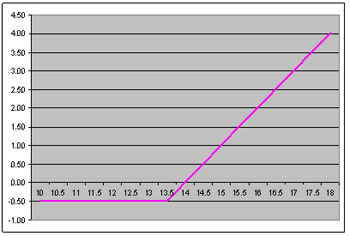
Investors who believe that a particular asset will appreciate in the near future can choose between a number of financial instruments: shares, ETFs, benchmarks (certificates), and should they wish to leverage, they can choose between futures and CALL options.
The latter instrument has an asymmetric expiration return profile as is evidenced by the chart below, i.e., against unlimited earnings, the loss is limited to the price paid for the option.
Compared with the other instruments, the CALL option allows using a financial leverage which is generally higher in respect of futures, shares and ETFs.
Volatility, interest rates and the dividends which will eventually be paid and, most of all, the duration of the instrument and, therefore, the passing of time are also critical when trading in options.
Unlike other non-derivative instruments, investors should pay particular attention to the timeframe to ensure the expected appreciation occurs within the chosen option duration and that such upside is greater than the depreciation which the instrument will suffer due to the passing of time (theta effect).
Another critical aspect in this type of trading is the volatility trend, i.e. the uncertainty that the market assigns to the future performance of the underlying. Unlike shares, the increase in market volatility leads to an important increase in the value of the CALL option, on a like-for-like basis.
Should the investor assume that, over the timeframe considered, market volatility may decrease, it is preferable to focus on futures.
Strategy: Bearish on the underlying
Investors who believe that a particular asset will depreciate in the near future can choose between a number of financial instruments: going "short" on shares and ETFs, and should they wish to leverage, they can choose between futures and PUT options. The latter have an asymmetric expiration return profile as is evidenced by the chart below, i.e., against unlimited earnings, the loss is limited to the price paid for the option.
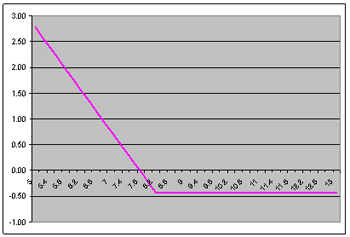
By comparison with other instruments, the PUT option makes it possible to use a financial leverage which is generally higher in respect of futures, shares and ETFs.
Volatility, interest rates and the dividends which will eventually be paid and, most of all, the duration of the instrument and, therefore, the passing of time are also critical when trading in options.
Unlike other non-derivative instruments, investors should pay particular attention to the timeframe to ensure the expected appreciation occurs within the chosen option duration and that such upside is greater than the depreciation which the instrument will suffer due to the passing of time (theta effect).
Another critical aspect in this type of trading is the volatility trend, i.e. the uncertainty that the market assigns to the future performance of the underlying. Unlike shares, the increase in market volatility leads to an important increase in the value of the CALL option, on a like-for-like basis.
Should the investor assume that, over the timeframe considered, market volatility may decrease, it is preferable to focus on futures.
Strategy: Moderate hikes on the horizon
The different phases of the market in relation to the performance of a specific financial asset can be classified as bullish (upward trend), bearish (downward trend) and range-bound (trading range).
Let’s assume that the investor has held a share in his portfolio during a bull cycle, but that, for some time now, the instrument has started to consolidate the achieved profits. Investors can monetise the gains by selling the share or decide to keep the instrument in portfolio and sell a Call option, pocketing the premium paid by the purchaser, should they believe that the underlying will not stray outside of a particular range in a given future timeframe.
The strategy is called "selling a covered call" and may be represented graphically as follows:
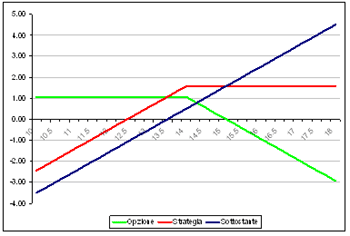
Let 's assume that, on 31 May 2017, the investor holds the Y share and that, after a substantial increase, he believes that the share price will remain stable for some time. In the chart above, the strategy was decided assuming that the sold Call had a strike price of €14, a market price of the underlying of €13.5, and an expiration date in December 17. The value of the sold Call is €1.07 and accounts for about 8% of the Y price.
When the option expires, if the share remains essentially stable (€14), but equal to the strike price (€14), the investor will pay anything, because the share price - strike price differential would be equal to zero (€14-€14). In this case, the yield obtained through the strategy will be equal to (€14 +€1.07)/€13.5, equivalent to almost 12%. If the investor only holds the Y share, he would have achieved a performance of 3.7% (€14-€13.5)/€13.5.
In the event of changes in the expectations of the underlying, the investor may decide to close the position, but the overall performance could be different.
For option sellers, on a like-for-like basis, the passing of time is an advantage, as every day that passes reduces the price of the instrument and, therefore, of any differential between the share and the strike price, to be paid at expiration to the purchaser of the option.
When the underlying decreases, the strategy would make it possible to contain losses up to a reduction of about €12.5, as shown in the chart.
For example, if the Y share drops at expiration from €13.5 to €13, the investor will suffer a loss on the underlying (€13 - €13.5), offset by the sale of the CALL option (€1.07), which cannot be exercised because the exercise price would be lower than the STRIKE price.
Conversely, if Y increases significantly, the investor who implemented this strategy will not benefit from it as the gains achieved with the underlying will be offset by the losses on the CALL option. For example, if, at expiration, Y reaches €16, the investor will obtain a gain equal to (€16-€13.5) thanks to the underlying, but with the CALL option previously sold IN THE MONEY, there would be a loss equal to €16-€14, which is higher than the pocketed premium of €1.07.
As can be seen in the chart, the strategy is characterised by predetermined maximum gains and potentially unlimited losses.
Strategy: Hedging
If an investor believes that the trend of a particular asset held may reverse, but he is not certain that this will occur, he could waive part of the profit and purchase a hedged PUT option on the same underlying. It is all about building a strategy that can define from the outset the maximum loss you are willing to suffer, for a given period of time, in return for the payment of the PUT option premium (price).
The chart below shows the performance profile of the strategy at expiration.
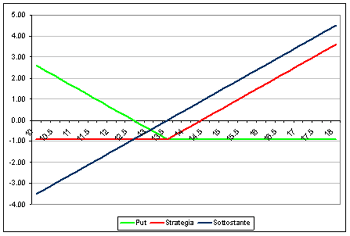
Let's analyse the investor, on 31 May 2017, with the Y share (€13.5) who, after a substantial increase, decides to hedge against a possible but uncertain drop in the share price.
The investor can purchase a PUT option with a STRIKE price of €13.5 which expires on 20/12/2017, paying a premium (price of the derivative) of €0.90.
The cost of the hedge is equal to 6.7% of Y's value (€0.90/€13.5) and represents the maximum loss to be incurred should the share price drop. If the price of the technological security were to continue its upward trend, the investor would witness a marked decline in the value of the PUT option until it is worth nothing. Therefore, the hedging strategy is comparable to taking out an insurance policy, in which a cost is incurred without knowing whether there will be any compensation in the future.
In order to reduce the hedging costs, the investor could purchase a PUT option "out of the money", for example, with a strike price of €13, bringing the cost of the Put option down to €0.68, i.e., to 5% of the Y price (€0.68/€13.5). In this case, the maximum loss with this strategy would be the possible drop in the value of the underlying (€13-€13.5), as well as the price of the PUT option (€0.68), for a total of (€0.5+€0.68), which is higher than the amount originally envisaged. If the adjustment is likely to be temporary and short term, the purchase of an OUT OF THE MONEY PUT option would be recommended, allowing a greater appreciation of the PUT option during a bearish market. Once the downtrend is deemed to be at an end, it would be advisable to sell the PUT option and only keep the share.
By way of example, if, on a like-for-like basis, the Y share were to drop by 10% over 4 days to €12.15, the PUT option value would rise from €0.68 to €1.27, resulting in a gain of more than 86% by virtue of the high FINANCIAL LEVERAGE that is typical of OUT OF THE MONEY options. Unfortunately, the same response could also occur in the negative case that Y continues its BULL MARKET phase, causing the option price to decrease.
Lastly, a long-term hedging strategy could produce a further cost: if you purchase a PUT option, expiring in December 2018, at a strike price of €13.5, the cost of the premium would rise to €1.35, which is approximately 10% of the notional invested.
Strategy: Investing in volatility (straddle, strips & straps)
The STRADDLE is useful when the investor expects a dramatic change in the price of the underlying, but is not certain about its direction. The period prior to the release of the financial results of a company or specific macroeconomic data may be considered as a typical example of this market situation. In this case, the security may go up or go down, but in a significant way, offering the possibility of earning a profit for those adopting this strategy.
The chart below outlines the STRADDLE strategy, which consists of the simultaneous purchase of a CALL and PUT option with the same strike price and expiration date. The strike price used in the example is €13.5 and the expiration date is 20/12/2017.
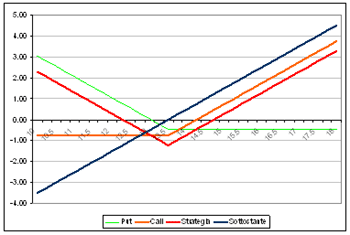
Let's examine the strategy at expiration: you can see that the position is profitable when the prices of the underlying are below €12.25 or above €14.75.
Let us assume that price of Y is €13.5, the market value of the CALL would amount to €0.75, while that of the PUT to about €0.46, for a total of €1.21.
If Y drops to €12 at expiration, the investor will obtain €1.5 from exercising the PUT option (€13.5-€12), but will lose the entire value of the CALL option. The overall yield of the strategy would be equal to €1.5/€1.21, i.e., almost 24%. If Y reaches €16 at expiration, the value of the PUT option will be reduced to zero as it is OUT OF THE MONEY, while the value of exercising the CALL option will be €2.5 (€16-€13.5), thus doubling the invested capital.
In order to be profitable, the STRADDLE requires significant changes in the price of the underlying, i.e. high volatility. If you consider that this variable may rise in the short term, it can be extremely profitable to sell the two options purchased early rather than wait for them to expire.
Let 's assume that on the same day the two options are purchased, market volatility rises from 15% to 16%. The market value of the strategy would increase by 6.4%, even though the underlying, as in the case of this example, remains unchanged. In fact, the value of the CALL option would increase from €0.75 to €0.79, while the PUT option would rise from €0.46 to €0.49, giving an overall value of €1.29.
However, the STRADDLE strategy is particularly vulnerable to the passing of time: if, in the above example, the number of days until expiration were to drop from 204 to 203, the strategy would lose, on a like-for-like basis, 0.25%. Moreover, this penalty is based on the residual life of the options and is generally likely to increase. For example, if the price of the underlying remains unchanged after 4 months (30/09/17), the value of the applied strategy would amount to €0.81, resulting in a loss of more than 33%.
STRIP & STRAP
Investors who anticipate some uncertainty in the near future, but who nonetheless believe that a drop rather than a rise in the underlying is more likely, can implement a STRIP strategy.
This strategy is implemented in the chart below: using the Y share and assuming that its price is €13.5, we purchased two PUT options with the same STRIKE and IN THE MONEY price and a CALL option with the same STRIKE price. All options used were envisaged as expiring in December 2017 and, as is often the case on the market, we used two different volatilities for the CALL and the PUT options.
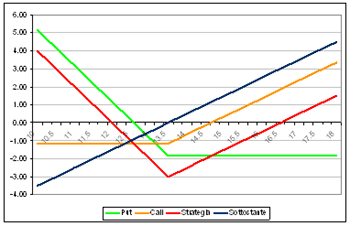
The cost of the CALL option is estimated at €1.15, while the put is €0.92, bringing the total strategy cost to €3. At expiration, the investor begins to earn money when prices are below €12 and above €16.5.
There is an increased response of this strategy during the life of the various options involved. Indeed, an increase in volatility of 1 on the same day the options are purchased would cause an increase of 3.93% in the overall market value of the STRIP.
Indeed, the value of the CALL option would increase from €1.15 to €1.18, while the two PUT options would rise from €0.92 to €0.96, amounting to a total of €3.12.
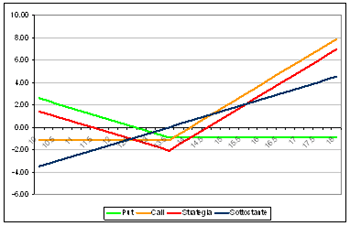
However, the STRIP strategy is particularly vulnerable to the passing of time: if, in the above example, the number of days until expiration were to drop from 204 to 203, the strategy would lose, on a like-for-like basis, 0.23%. Moreover, this penalty is based on the residual life of the options and is generally likely to increase as seen in the STRADDLE example. Although similar to the STRIP, the STRAP is always recommended in times of uncertainty. However, in our example, the investor believes that a rise, rather than a drop, in the value of the underlying is more likely. The strategy is implemented by purchasing 2 CALL options and 1 PUT option with the same STRIKE price and duration.
The observations concerning high response to volatility and the passing of time that need to be made for the STRIP are also valid for the STRAP.
Strategy: Investing in volatility (strangle)
The STRANGLE strategy is very similar to the STRADDLE, except that it allows for reduced costs in return for a higher level of risk.
The lower cost of the STRANGLE compared with the STRADDLE is due to the fact that both options purchased are OUT OF THE MONEY and, thus, require larger changes in the price of the underlying than those that occur with the STRADDLE
. Let’s assume that the price of Y is €13.5 and that the STRANGLE was implemented by purchasing a CALL option with a strike price of 14.5 and a PUT option with a strike price of €12.5, with the same expiration date of 20/12/17.
As shown in the chart below, the strategy makes it possible to achieve profits when prices of the underlying are below €12 and above €15. The cost of the CALL option is €0.33, while that of the PUT option is €0.14.
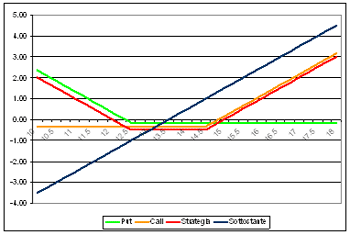
If Y were to drop to €11 by the expiration date, the value of the PUT option would be €1.5 (€12.5-€11), while that of the CALL would fall to zero. The outcome of the strategy is positive, since, with an initial investment of €0.48, the gain is €1.5, an increase of more than 200%.
During the life of the two options, the response of the strategy to volatility increases is lower than with the STRADDLE, since the rise in volatility from 15% to 16% would cause the value of the strategy to increase by 5.45%. It is recommended to close the position without waiting for the two options to reach expiration.
Conversely, the exposure of the strategy to the passing of time is lower than with the STRADDLE and the loss related to the passing of one day is equal to 0.14%, assuming 204 days to expiration.
The depreciation rate is based not only on the residual life but also on the changes in the value of the underlying as well as other variables (volatility, interest rates and dividends).
Strategy: Long and short
Investing in the stock market involves taking two types of risk: general market risk and the specific risk if the subject is an individual security.
Many investors have experienced how in general, during downturns and upturns, the extent of changes varies according to the share.
Those who have achieved advanced levels of trading, might be interested in purchasing a stock which is considered particularly positive as it is believed it may be the subject of a takeover bid, but at the same time it is believed that the price list as a whole may reverse.
In this case, the following strategy may be implemented:
- you purchase the individual stock or the future if you intend to use leverage
- you purchase a PUT option on the FTSE MIB index.
Should the investor's assumptions come true, a profit can be made on both positions or on the performance differential.
In other circumstances, investing in a particular index through an ETF or an option or future (e.g., on the FTSE MIB) may be interesting, but only if you expect that a security is set to fall despite the overall climate of the market being positive (e.g., Alitalia). In this case:
- you purchase an ETF, an option or a future on the FTSE MIB index
- you purchase a PUT option on Y.
The Long/Short investment strategy can also be used by combining two stocks with some special bond; a typical example is when they belong to the same product sector. An interesting example is the purchase of company Z share and the purchase of a PUT option on Y. Alternatively, you can purchase a CALL option on W and a PUT option on K.
These types of strategies are very risky and can produce attractive returns both on the LONG and SHORT term, but also considerable losses, thus requiring thorough understanding of the tools and a strict discipline in following a specifically identified STOP LOSS/GAIN.
Strategy: Bearish with hedging
Investors struggling with a bearish position may wish to contain their losses through an appropriate hedging strategy. Let’s assume that the investor has opened a bearish position on the X index, positioned at 43000, selling the future, but intends to limit the possible losses by deciding ex ante the maximum down side by purchasing a CALL option with strike 45000.
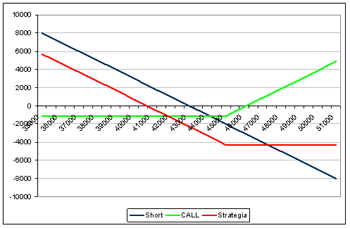
The cost of the PUT option would amount to about 1145 index points (€2862, 2.66% of the SPOT). In this case, the maximum loss would be equal to approximately 10% of the value and, moreover, the overall strategy would become profitable for index values below 41000.
A rise in volatility will set the appreciation of the option during its life.
In order to implement a correct strategy, it is necessary to consider not only the notional amount of each contract used, but also the fact that the two contracts generally have a different leverage and, thus, different responses to changes in the value of the underlying.